Henry Nathaniel McGuinness
Henry was born in London to Jewish parents, he claimed his birth was on August 3rd, 1839. However, he was born on the August 19th, 1839, at 56 Crown Street, Finsbury and given the name of Henry Magnus.
As a young man he lived in the northern borders of the old City of London.
Henry’s father was Nathaniel Magnus, a shoemaker and his mother was called Hannah, (nee Moses). Henry had several full and half siblings including brothers Abraham and Albert. In 1844 his mother Hannah passed away, and Nathaniel remarried.
Henry emigrated, reason unknown, and was just eighteen years old when he arrived at Castle Garden, New York on June 29th, 1857, having disembarked the SS Devonshire. Like so many other emigrants, he may have left England for adventure choosing to seek his fortunes in the United States. However, New York was not the land of milk and honey he had perhaps hoped for as research has determined that Henry was admitted to New York City’s alms-houses on February 29th, 1860.
On August 8th, 1860, according to the federal census, Henry was resident in Newhaven, employed as a tailor living with the family of Abraham Newmark. Abraham was Polish and a tailor by trade. Henry gave his occupation as tailor, surname as Maginnus, and place of birth as England.
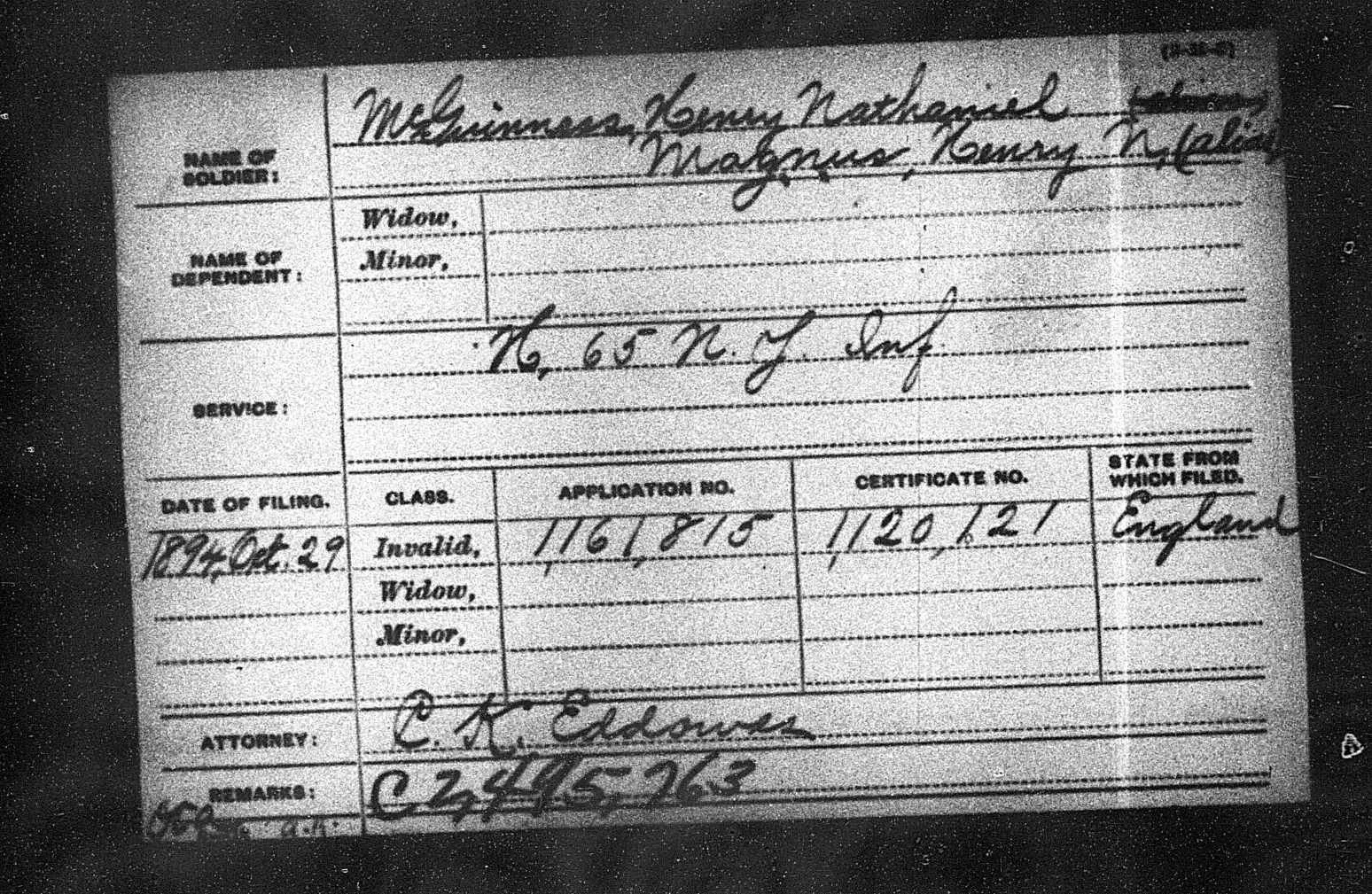
Within a year the Civil War started, and Henry chose to enlist in the summer of 1861. He claimed his surname was changed from Magnus to Maginis on account of his parents disagreeing with his choice to join the army because Judaism could not be practiced.
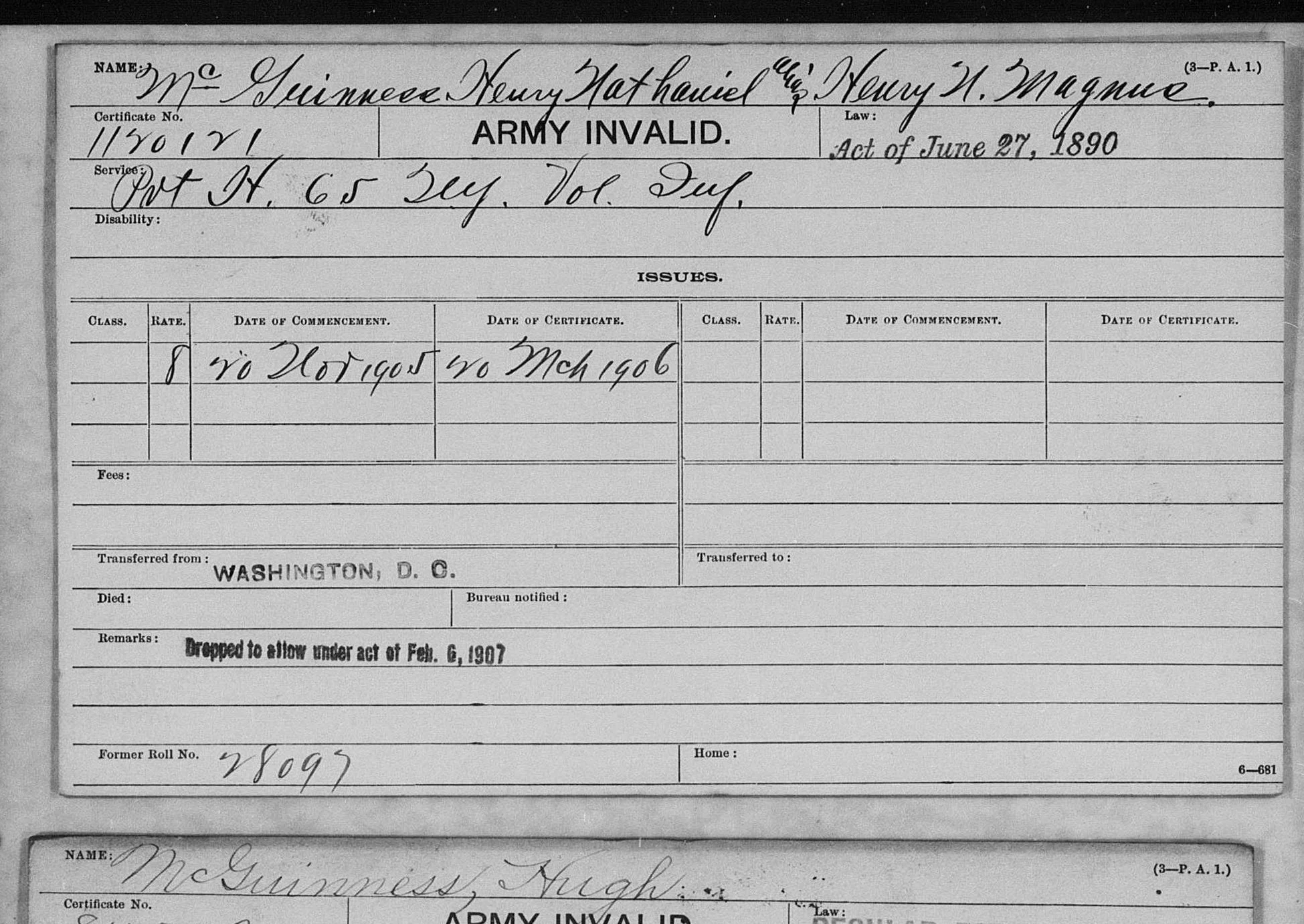
Henry joined Company H, 65th New York Infantry at Hartford, Connecticut on August 20th, 1861. His service with the regiment is likely to have included battles at Yorktown, Antietam, Fredericksburg, Gettysburg, Bristoe Campaign, Battle of the Wilderness, Spotsylvania Court House, Cold Harbor, Petersburg, and the Battle of Appomattox Court House.
Five months after the Battle of Gettysburg in 1863, Henry’s term of service was up, and he was eligible for discharge whilst at Brandy Station on December 24th, 1863. Despite the horrors of war he had already experienced, Henry promptly reenlisted. As a veteran of the regiment, he only became detached from his comrades due to rheumatic fever when he was hospitalised at City point, Virginia where he remained for about two months in 1864. During the Autumn of 1864 Henry became a casualty of war again, when he was present at the battle of Cedar Creek, Virginia.
It was also at Cedar Creek, on October 19th where the 65th also sustained the regiments highest number of losses. During the battle 12 men were killed, 74 wounded, and four reported as missing in action. During the action a Confederate round grazed his left shoulder, the wound was slight but still created a permanent scar and reminder of the historic battle. A medical examination that took place on March 18th, 1895, confirmed the presence of Henry’s old injury. The surgeon wrote, “There is a scar on the back of left shoulder said to be due to a graze of a bullet”.
Having survived his Cedar Creek injuries Henry served honourably until he mustered out of the regiment on July 17th, 1865, at Hall's Hill, Virginia. Ongoing research suggests he may have joined the regular army after the Civil War.
After his discharge Henry settled in Connecticut and later relocated to Pittsfield Massachusetts, where he set up a tailoring business. Described as an “Enterprising tailor” in the press, research suggests he got involved with civic duties, temperance and the church but also had some financial difficulties.
Those struggles led to his return to England in about 1876 where he settled in Birmingham and entered into a relationship with Mary Madigan. Five years later their union ended, and Henry moved to Nottingham. In time he moved again and settled in Derby. He became a self-professed atheist and entered into a relationship with a widow called Bertha Harris. They married but sadly Bertha died on January 22nd, 1906.
Whilst resident in Derby he became involved with the City’s democratic league where he often spoke and was deemed a very eloquent public speaker. At one league meeting Henry read a paper he had written entitled, “War; its demoralisation and cost”. It is a useful illustration of Henry’s feelings having served in some of the most significant battles of the Civil War. He outlined that religion had a tendency to glorify conflict, and caused moral disengagement in the treatment of even enemies who still had equal rights, “That war had a demoralising effect was proved by the fact that English people, who in their normal state liked fair play, yet in times of war appeared to accept the narrowness embodied in the old saying, “Love all Frenchmen like the devils’. Mr McGuiness desired those present to remember the words of Cowper, ‘War is a game that Kings would not play at all if people were wise’. He gave many statistics to show the awful costliness of war…”
It was among others that had experienced the awful cost of war that Henry also found peer support. In Derby’s Imperial Veterans Association, a friendship formed with Samuel Lander Hough, another civil war veteran.
Henry later married Harriet Green, a widow whose maiden name was Hardy. However, he soon separated from her, on account of her “inebriation and immorality”.
Three years later on July 4th, 1916, Samuel and Henry made their way to London to meet the London Branch of civil war veterans, founded by John Davis (USS Tulip). Henry and John were born the same year, and in youth had similar lived experience. It is felt that John Davis may have seen some of himself in Henry, which may explain why he travelled from Bermondsey to Derby to attend his old comrade’s funeral.

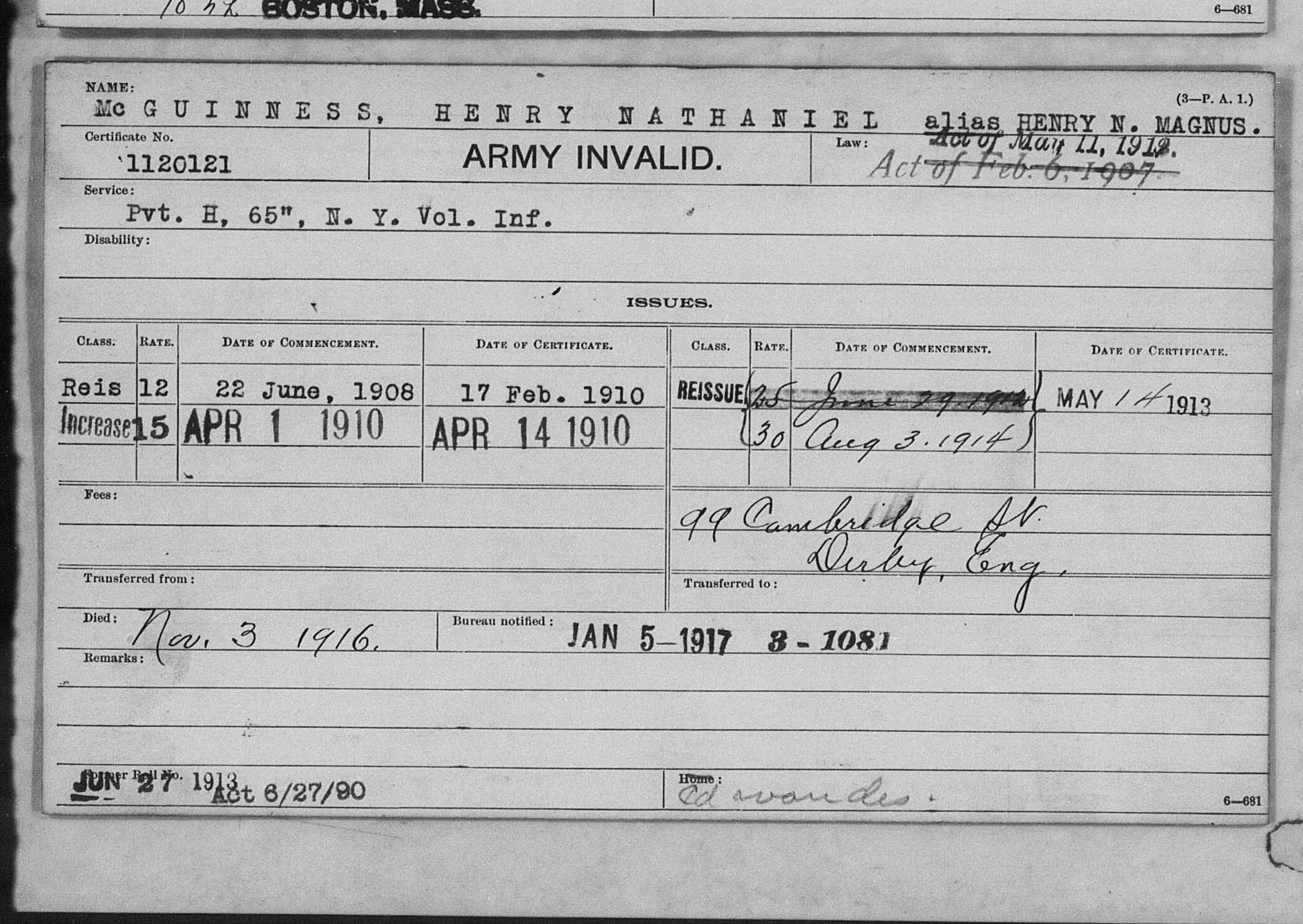
Henry’s death on November 3rd, 1916, was attributed to bronchitis and asthma. His passing occurred at Derby workhouse infirmary. The informant was his ‘immoral’ widow, Harriet. There was no love lost between them even if she registered his death. Following his passing Vice Consul Henry Webber reported the dying veterans last wish in a letter to the pension bureau, “As far as I am able to ascertain, Mr. McGuinness, who was a British subject, was married a few years ago in Derby, England to an English woman, 25 or 30 years younger than himself. I am informed that this woman, who is still residing in the place last mentioned, married him with the apparent intention of securing his pension at the time of his death, to which she was under the impression she would be entitled, but after the marriage had taken place, she learned that she would not be entitled to her husband's pension upon his death, on account of the United States pension laws covering marriages after 1898.
Further I learn, on good authority, that she was constantly neglecting her husband, and generally speaking, was considered a woman of loose morals. Her late husband and she lived apart on numerous occasions for the reason last stated, and had it not been for the friendship which existed between Mr. Samuel Hough (Co G, 2nd New Jersey Cavalry), who is also a US pensioner, the deceased, undoubtedly, would have had a pauper's grave and funeral. Mr. Hough explained to me that one of the last requests which Mr McGuinness made before dying was out of his effects, the sum of one shilling to be given to his wife with which to purchase a rope to hang herself…”.
His passing was reported in the local press, which reveals that John Davis, founder of the London branch, despite his own ill-health (he died two months later), made his way from London to honour Henry. John had vowed to ensure veterans of the Civil War had the stars and stripes flag adorned across their coffin, and it seems this ritual was observed at the funeral. Samuel Hough paid the funeral costs. A bugler attended to sound the ‘Last post’ and the coffin was covered with the Union Jack and the Stars and Stripes.
Henry was buried with his previous wife Bertha McGuinness (nee Harris). Even though Henry was clearly revered, no burial marker was ever provided. Bertha is named on the grave marker as the wife of Henry McGuinness. There is no indication that Henry lies there also.
On October 4th 2025, a military headstone was at last provided for Henry. This was placed not on the grave, but close by, next to a headstone to his friend Samuel Lander Hough.